
Your Insurance Paid Fast — and That Should Make You Nervous

The check arrived before you even finished sorting your medical bills. That speed felt like a relief. I want you to sit with something, though: the insurance company’s efficiency is not the same as your fairness.

I spent years on the defense side of these cases, watching how quickly first-party claims move when an insurer wants them to. Now I work with the people who cashed those checks and called me six months later, confused about why their wage loss still wasn’t covered, or why their doctor’s notes didn’t match what the adjuster had on file. The pattern is consistent enough that I feel compelled to write this down.

When “Handled” Doesn’t Mean “Resolved”

Picture two people. Both were rear-ended at a stoplight in suburban Detroit. Both received PIP payments within two weeks.

ClaimantInjuryOutcome
Person ASoft-tissue soreness, resolved in one monthFast payment was genuinely appropriate
Person BHerniated disc, didn’t fully declare until week sixAccepted initial payment, missed window for additional wage-loss benefits

Same speed. Completely different outcomes.

That gap is what I work in. The first person did fine. The second person didn’t lose rights because the insurer was predatory — he lost ground because he didn’t understand what the payment actually covered, and what it left open.

What No-Fault Insurance Actually Does (and Doesn’t Do)

No-fault insurance exists to remove the friction from immediate post-accident recovery. In Michigan, New York, and Pennsylvania, the law requires your own insurer to pay your initial medical costs and a portion of lost wages regardless of who caused the crash. That’s the “no-fault” part — fault is temporarily irrelevant to your first-party claim.

Personal injury protection, or PIP, is the specific coverage that funds this. As an insurance policyholder in a no-fault state, you’re not filing against the other driver’s insurer first. You’re filing against your own policy. That distinction matters more than most people realize, because it means the adjuster you’re dealing with works for your company — and your company has an interest in resolving claims at the lowest defensible number.

What PIP typically covers:

  • Emergency and ongoing medical expenses
  • A percentage of lost wages
  • Replacement services (paying someone to perform household tasks you can’t manage while injured)

What PIP does not cover:

  • Pain and suffering
  • Emotional distress
  • Long-term disability beyond the policy’s benefit window

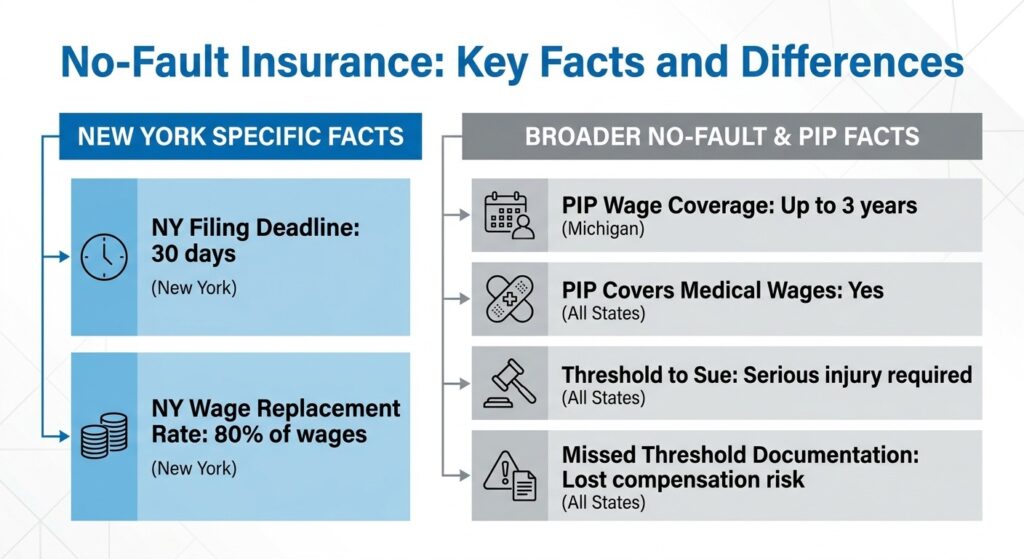
Michigan’s official no-fault guidance confirms that PIP wage-loss and replacement-service benefits are payable for up to three years after the accident date — which sounds generous until you realize that clock starts immediately, and many people don’t begin tracking it seriously until months in.

The other thing no-fault doesn’t do: it doesn’t automatically close the door on a separate personal injury lawsuit. That’s the piece most first-time claimants don’t know exists.

The Timeline That Quietly Controls Your Options

Here’s where things get procedurally dangerous for people who assume a fast payment means everything is settled.

New York requires you to file your no-fault application within 30 days of the accident. Miss that window and your insurer can deny the entire claim — not reduce it, deny it. The NY no-fault filing rules require specific forms, including the NF-2 application, and incomplete or late submissions give insurers a clean procedural basis for denial. This isn’t a technicality buried in fine print; it’s a hard deadline that catches people who assumed their verbal report to the insurer was sufficient.

Pennsylvania operates under a “choice” no-fault system. You may have already selected — possibly years ago when you bought your policy — whether you retain the right to sue for pain and suffering. If you chose the “limited tort” option to save on premiums, your threshold for stepping outside no-fault is higher. Most people don’t remember making that choice.

Michigan’s system is the most complex of the three. The 2019 reforms created tiered PIP coverage levels, meaning two people in the same accident might have dramatically different medical benefit caps depending on what their policies say. If you’re in Michigan and you’re not certain which PIP tier you selected, that’s the first call you need to make — not to your adjuster, but to your own policy documents.

The timeline concern isn’t just about filing deadlines. Soft tissue injuries, concussions, and disc problems often worsen or become clearer in the weeks after an accident. If your medical provider isn’t documenting the progression of your symptoms carefully — every visit, every complaint, every functional limitation — the adjuster’s file will reflect a picture that looks like recovery, even when your reality is different.

The Threshold Question Nobody Explains at the Scene
This is the part of no-fault law that creates the most confusion, and the most lost compensation.

Every no-fault state has a threshold — a legal standard that, if your injury meets it, allows you to step outside the no-fault system and pursue a personal injury claim against the at-fault driver for damages PIP doesn’t cover.

Q: What is New York’s serious injury threshold? Significant disfigurement, fracture, permanent limitation of a body organ or member, or a medically determined injury preventing you from performing substantially all daily activities for 90 of the 180 days following the accident.

Q: What does “medically determined” actually mean in practice? Your medical provider must document the injury in clinical language, with objective findings — not just your self-reported pain level. An adjuster reviewing your file is not looking for reasons to flag your injury as threshold-meeting. They’re evaluating whether the documentation supports continued PIP payment. Those are different analyses.

If you’re in New York and you missed more than 90 days of normal activity, but your doctor’s notes only say “patient reports discomfort” rather than documenting functional limitations with objective findings, you may have a threshold injury that the record doesn’t support. That’s not the insurer’s fault. That’s a documentation gap between what your body experienced and what your medical provider wrote down.

For Michigan claimants, the threshold is “serious impairment of body function” — an objectively manifested impairment that affects your general ability to lead your normal life. Pennsylvania’s limited tort threshold requires “serious injury” as well, though defined somewhat differently. The point across all three states: a fast PIP payment does not mean your injury didn’t meet the threshold. It means the threshold question hasn’t been asked yet.

If you’re wondering whether your situation warrants that analysis, consulting a personal injury attorney ma or a no-fault specialist in your state is the appropriate next step — not to file a lawsuit, but to understand whether the threshold question is even on the table.

What the Adjuster Is Evaluating vs. What You Think They’re Doing

People often assume the insurance adjuster’s job is to figure out what you’re owed.

That’s not quite right.

The adjuster’s job is to evaluate what the policy requires the insurer to pay, based on the documentation in front of them. They’re not your advocate. They’re not your enemy either — but they’re working within a system designed to resolve claims efficiently, and “efficiently” in insurance means within documented parameters. What this means practically: the adjuster is looking at your medical provider’s records, your employer’s wage verification, and your policy’s coverage tier. If your provider submitted billing codes that don’t match the injury narrative, or if your employer’s wage documentation is incomplete, the adjuster will process what’s there — not what should be there.

Two additional details that catch people off guard:

  1. New York’s 20% wage offset. The statutory wage offset means the system is designed to pay you 80% of your pre-accident wages, not 100%. Many claimants assume a wage-loss payment equals full income replacement. It doesn’t. If you’re calculating whether the payment covered your actual income loss, subtract 20% from your gross wages before comparing.
  2. Exhausted PIP benefits. If your basic PIP benefits run out — which can happen with serious injuries requiring extended treatment — additional coverage options exist through supplemental PIP on your policy or a household member’s policy, and ultimately through your standard health insurance. Most claimants don’t know to ask about additional PIP until they’ve already hit the limit.

A Practical Triage Checklist

Before you decide whether your claim is truly resolved, work through these:

On your PIP claim:

  • Do you know your policy’s specific PIP coverage tier and benefit limits?
  • Have you confirmed the adjuster’s file reflects all your medical visits and documented symptoms?
  • If you’re in New York, did you file the NF-2 within 30 days?

On your medical documentation:

  • Is your provider recording functional limitations — not just pain, but what you can’t do?
  • Are follow-up appointments scheduled if symptoms persist or worsen?

On the threshold question:

  • Have you had a frank conversation with a no-fault-experienced attorney about whether your injury might qualify for a separate personal injury claim?
  • This conversation costs nothing and doesn’t commit you to litigation.

On wage loss:

  • If you’re in New York, are you accounting for the 20% offset?
  • Have you submitted complete employer wage verification?

A fast payment means the no-fault system worked as designed for your immediate bills. It does not mean the full picture of your rights has been evaluated.

Where to Go From Here

Start with your state’s insurance department. The New York Department of Financial Services no-fault FAQ is genuinely useful, as is Michigan’s consumer auto insurance guide. Both are written for non-lawyers and answer the most common procedural questions without requiring you to contact anyone.

For threshold injury analysis or situations where you suspect your documentation is incomplete, a no-fault-experienced plaintiff’s attorney — not a general practice firm — is the right resource. Most offer free consultations. Use them to ask specific questions, not to hand off your case before you understand it.

The goal here isn’t to make you suspicious of every payment. It’s to make sure you know what the payment covered — and what it didn’t.

What Riders Get Wrong About Settling Fast After a Crash

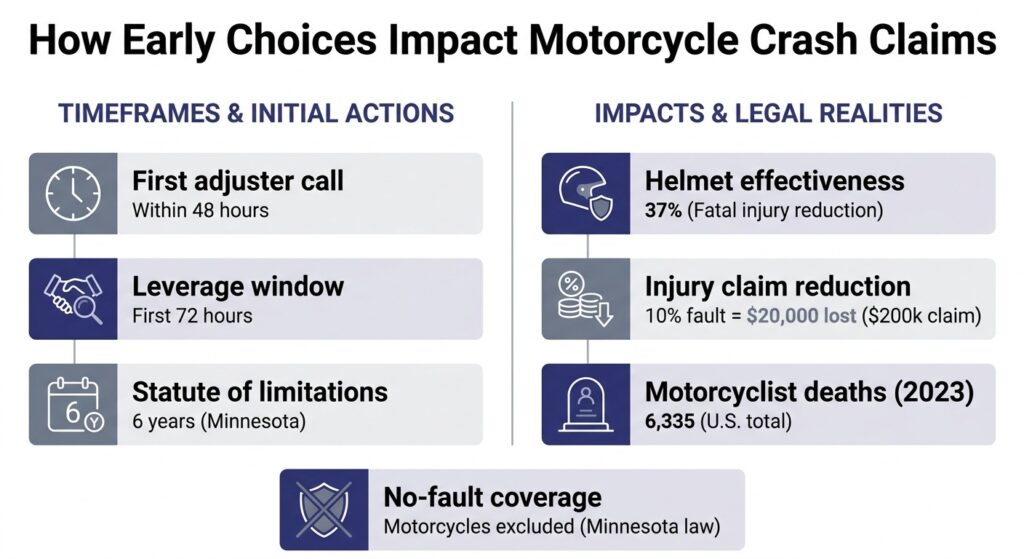
Most riders I talk to after a crash aren’t trying to game the system. They’re tired, they’re hurting, and they just want to get back to normal. So when the insurance adjuster calls within 48 hours sounding reasonable and helpful, it feels like a lifeline. Sign here, take the check, move on.

I’ve watched that moment go wrong more times than I can count. Not because the rider was naive — because nobody told them what was quietly happening on the other side of that phone call.

The Moment That Sets Everything in Motion

Picture this: a rider gets clipped by a left-turning sedan on a Tuesday evening near Lyndale and 38th. He’s shaken, his bike is down, and there’s road rash on his left arm. The police arrive, write up a report, and the other driver’s insurer calls the next morning.

The adjuster is polite. Asks a few questions about how fast he was going and whether the light had changed. He answers honestly. He thinks he’s just telling the story.

Three weeks later, when his shoulder pain turns out to be a torn labrum requiring surgery, that early conversation has already shaped the claim. His speed estimate — offered casually, without context — is now part of the file. His phrasing about the light is being read as ambiguous. The adjuster wasn’t being friendly. They were building a record.

This is the before-and-after that I see constantly in the Twin Cities. The crash itself is one event. The claim is a second event that starts immediately and runs on its own timeline, and most riders don’t realize they’re already in the middle of it.

How the First 72 Hours Shape the Rest of the Claim

The chronology matters more than people expect. What you do — and say — in the first three days can either preserve your leverage or quietly erode it. Here’s how each element plays out:

ActionWhat Most Riders DoWhat Actually Helps
Adjuster callAnswer all questions fullyConfirm name and crash occurred; defer details
Police reportAssume it settles faultObtain a copy and check for errors
Bike and gearRepair or discard quicklyPreserve everything as evidence
Witness contactAssume police handled itCollect names and numbers at the scene

The adjuster call. When the other driver’s insurance company calls, they’re not calling to help you. They’re calling to gather information while your memory is fresh and your guard is down. Comparative fault rules mean that anything you say about your speed, your lane position, or your reaction time can be used to assign you a percentage of fault — and in Minnesota, that percentage directly reduces your recovery.  You don’t have to be rude. You do have to be careful. Confirming basic facts like your name and that a crash occurred is reasonable. Narrating the entire sequence of events without legal guidance is not.

The police report. Most riders assume the police report settles the fault question. It doesn’t. What it does is create an early official record of scene details — location, time, vehicles involved, contributing circumstances — and federal crash reporting standards make clear that these reports are foundational documents in any subsequent claim. But officers aren’t accident reconstructionists. Their notes may contain errors, incomplete witness accounts, or a fault notation based on limited information. You’re entitled to obtain a copy and, if necessary, challenge inaccuracies before they calcify into accepted fact.

Physical evidence. The bike, the gear, the helmet — these aren’t just property. They’re evidence. NHTSA data shows helmets are roughly 37% effective in preventing fatal rider injuries, which means insurers know exactly how to argue about helmet condition when disputing injury severity. Don’t repair the bike immediately. Don’t throw away damaged gear. Photograph everything before anything is moved or cleaned.

Witness information. People who saw the crash will scatter within hours. Getting names and phone numbers at the scene — or having someone do it for you if you’re injured — is the kind of thing that sounds obvious in retrospect and gets skipped constantly in the chaos of the moment.

Documentation: The Part Nobody Wants to Do When They’re Hurt

This is where I push back hardest on the “just settle and move on” instinct. The documentation phase is where claim value is either built or abandoned. Full stop.

Medical records are your claim’s backbone. The gap between “I was hurt” and “here is documented proof of what I suffered, what it cost, and what it will continue to cost” is enormous. Insurers don’t pay for pain — they pay for documented, verifiable injury. That means going to the ER even if you feel okay, following up with specialists, and not skipping appointments because you’re busy or because you feel like you’re being dramatic. Every missed appointment is a gap in the record that an adjuster will use to argue your injuries weren’t that serious.

Delayed symptoms are real and routinely dismissed. Soft tissue injuries, concussions, and internal injuries don’t always announce themselves at the scene. If you feel fine on day one and wake up with neck pain on day four, that’s not unusual — but if you haven’t established a medical record, the insurer will argue the injury happened elsewhere or isn’t related to the crash.

Keep a pain journal. This sounds small. It isn’t. A daily log of how your injuries affect your sleep, your work, your ability to ride or exercise or pick up your kids — this becomes part of the non-economic damages picture. It’s not about being dramatic. It’s about having a record that reflects what you actually lived through.

A note on gear preservation: If you were wearing proper equipment and the insurer tries to argue your injuries were worsened by inadequate protection, your preserved helmet and gear become a direct rebuttal. Discarding them hands the other side an easy argument.

Fault Determination: How It Evolves and Why It’s Not Fixed

Here’s something most riders don’t realize: fault isn’t determined once.

It gets negotiated, argued, and sometimes litigated over weeks or months. Minnesota follows a modified comparative fault rule, which means you can recover damages as long as you’re found to be less than 51% at fault — but your recovery is reduced by your percentage of fault.

To make that concrete:

  • A $200,000 claim where you’re found 10% at fault → you recover $180,000
  • The same claim where you’re found 30% at fault → you recover $140,000
  • The difference between those two outcomes: $40,000 — often hinging on early statements

This is why what you say early matters so much. An offhand comment about your speed, a vague statement about whether you had time to brake — these get folded into the fault calculation. And once they’re in the file, they’re hard to walk back.

Motorcycle accident laws in Minnesota also include specific considerations around lane splitting (it’s illegal here), helmet requirements, and how comparative fault applies to riders. These aren’t abstract legal points. They’re the framework an adjuster uses to evaluate your claim before you ever see a settlement number.

The police report may show the other driver cited for failure to yield. That’s meaningful, but it doesn’t automatically mean you bear zero fault. Insurers routinely argue that a rider’s speed or positioning contributed to the crash even when the other driver was cited. Understanding this dynamic — that fault determination is a process, not a verdict — is one of the most important shifts in thinking I try to help riders make.

“I Don’t Need a Lawyer — It’s Pretty Straightforward”

I hear this constantly. And I understand it.

Nobody wants to feel like they’re escalating a situation. Nobody wants to be the person who “lawyered up” over a fender bender. And honestly, not every motorcycle crash requires a personal injury attorney.

But here’s what I’ve seen: the claims that look straightforward at first are often the ones that get complicated quietly. A soft tissue injury that turns into a surgery. A fault dispute that surfaces two months in. A medical bill that exceeds the initial settlement offer by three times.

A boston motorcycle accident attorney — or any experienced motorcycle injury attorney in your area — doesn’t just file lawsuits. The more immediate value is in the early guidance: knowing what not to say to the adjuster, understanding what your medical records need to show, and recognizing when a settlement offer is genuinely fair versus when it’s designed to close a claim before the full picture emerges.

What changes when you have representation:

  1. The adjuster’s tone changes — you’re no longer the easiest path to a closed file
  2. The documentation process gets structured by someone who knows what gaps will be exploited
  3. The timeline shifts — you stop being rushed toward a number that benefits the insurer
  4. You stop navigating a system designed by professionals while you’re also trying to heal

The other thing worth knowing: most personal injury attorneys who handle motorcycle claims work on contingency. You don’t pay unless they recover something for you. The financial barrier that keeps riders from even making a call is often not what they think it is.

Minnesota’s Legal Framework: What Matters Here

A few specifics that change the math for Minnesota riders:

Statute of limitations. Six years for personal injury claims — longer than many states. That’s not an invitation to delay. It’s a reason not to panic into a premature settlement.

No-fault exclusion. Minnesota operates under a no-fault insurance system for some benefits, but motorcycle riders are specifically excluded from the state’s no-fault PIP (Personal Injury Protection) coverage. This means riders are more dependent on the at-fault driver’s liability coverage and their own underinsured motorist coverage than car drivers typically are. Knowing this before you negotiate matters.

The scale of what’s at stake. Federal fatality data shows 6,335 motorcyclists were killed in U.S. traffic crashes in 2023. These claims aren’t minor fender-bender disputes. They involve real injuries, real financial stakes, and a legal framework that rewards the side that’s better prepared.

One Step Before You Decide Anything

You don’t have to file a lawsuit. You don’t have to hire anyone today.

But before you accept any offer or give any recorded statement, take one step: talk to someone who has seen these claims from both sides. Not because you’re being aggressive — because you’re being careful. There’s a meaningful difference between being money-hungry and making sure you don’t sign away your right to cover a surgery you don’t know you need yet.

Slow is safe here. The adjuster’s timeline isn’t your timeline, and you’re allowed to take the time to understand what you’re actually deciding.

Transform Challenges into Opportunities: Crown Point Attorneys Offer Innovative Strategies for Complex Problems

Navigating the complexities of personal injury cases requires more than just legal knowledge; it demands a compassionate approach and a commitment to transforming challenges into opportunities for your recovery. When you’re facing the aftermath of an accident, you need a trusted legal partner who understands the emotional and financial burdens you carry.

Your Path to Recovery Starts Here

Finding the right attorney is crucial, and we want to make it as easy as possible to reach us. Located at 11890 Broadway, Crown Point, IN 46307, The Ahearne Law Firm is conveniently accessible from various key locations. Here’s how to find us:

Directions to The Ahearne Law Firm (25 Railroad Avenue, Warwick, NY)

♦️From Lake County Historical Museum:

  • Begin at the Lake County Historical Museum in Crown Point.
  • Head east on Joliet Street toward Main Street.
  • Turn right onto Main Street.
  • Turn left onto Court Street and continue.
  • Upon reaching Broadway, turn left.
  • Travel north on Broadway for about 2 miles.
  • Look for our office at 11890 Broadway, which will be on your right.

♣️From Lemon Lake County Park:

  • Start by heading north on County Line Road from Lemon Lake County Park.
  • Turn left onto 109th Ave. and continue straight.
  • At Broadway, make a right turn.
  • Continue north on Broadway.
  • Our office at 11890 Broadway will be on your right-hand side.

♠️From the Old Lake County Courthouse:

  • Start from the Old Lake County Courthouse.
  • Head east on Joliet Street towards Main Street.
  • Turn right onto Main Street.
  • Turn left onto Court Street and continue.
  • Turn left onto Broadway and proceed north.
  • Arrive at 11890 Broadway; the office will be on the right.

Our commitment goes beyond legal representation. We prioritize your healing and recovery, working tirelessly to secure the compensation you need to move forward. We understand that each case is unique, and we tailor our strategies to meet your specific needs.

CID of Area – https://www.google.com/maps?cid=4131029056898909047

Why You Need a Trusted Spokane Divorce Attorney to Navigate Your Legal Process

Do you need legal help with a divorce in Spokane, but only want to work with trusted legal professionals? If you’re searching for a Spokane divorce attorney who understands the complexities of Washington State divorce law and can provide compassionate and effective representation, look no further than Hodgson Law Office. We are conveniently located at 1321 W Broadway Ave, Spokane, WA 99201, USA. Here’s how you can find us:

🚗Spokane City Center:

Start on W Main Ave heading west toward S Wall St.

Turn left onto N Wall St.

Continue on N Wall St for about 0.5 miles.

Turn right onto W Broadway Ave.

Hodgson Law Office will be on your left at 1321 W Broadway Ave after about 0.2 miles.


🛍️Spokane International Airport:

Exit Spokane International Airport and head east on W Airport Dr.

Continue straight to stay on W Airport Dr, which will turn into W 1st Ave.

Continue on W 1st Ave for approximately 4 miles.

Turn left onto N Wall St.

Continue straight onto W Broadway Ave.

Hodgson Law Office will be on your left at 1321 W Broadway Ave, Spokane, WA 99201.


🚉Spokane Valley:

Head west on E Sprague Ave toward S Pines Rd.

Continue straight to stay on E Sprague Ave for about 4 miles.

Turn right onto N Division St.

Continue on N Division St for 2 miles, then turn left onto W Broadway Ave.

Hodgson Law Office will be on your right after 0.5 miles at 1321 W Broadway Ave, Spokane, WA 99201.

Driving Direction: From Spokane City Center to Hodgson Law Office Spoketanehttps://maps.app.goo.gl/7MvqYaVnLEms9rpv7

Advocating for Justice: The Role of Northwest Florida Personal Injury Lawyers

Personal injury law is a field rooted in the need for justice and fairness for those who suffer harm due to others negligence. Florida personal injury lawyers, particularly in the Northwest, have carved out an essential role in advocating for individuals whose lives have been disrupted by accidents, workplace injuries, or other unfortunate incidents. These legal professionals work diligently to ensure victims receive rightful compensation, medical support, and a sense of justice after their ordeal. Continue reading “Advocating for Justice: The Role of Northwest Florida Personal Injury Lawyers”

Navigating Will Contests: How a Skilled Estate Planning Attorney Can Help

Securing your family’s future is a paramount concern. This article emphasizes the importance of proper estate planning and the role of a Bay Area estate planning attorney. Crafting a comprehensive estate plan ensures that your assets are distributed as per your wishes, minimizing potential disputes and challenges. A skilled Bay Area estate planning attorney can guide you through the intricacies of estate planning, helping you protect your family’s financial security and well-being. Continue reading “Navigating Will Contests: How a Skilled Estate Planning Attorney Can Help”

What Happens When There’s No Will? Transfer of Property After Death

Estate planning is crucial for financial security and family welfare. This article emphasizes the significance of estate planning, particularly when there’s no will. In the absence of a valid will, intestate succession governs the asset transfer process. Discover how the transfer of property after death without will in California operates. Learn about inheritors, asset distribution, the importance of legal experts, and why consulting a will-contest lawyer is vital in navigating this complex landscape. Continue reading “What Happens When There’s No Will? Transfer of Property After Death”

Conservatorship Lawyers: When Guardianship Becomes Necessary

In the legal realm, the need for guardianship or conservatorship can arise when individuals can’t make decisions independently. This article explores the vital role of conservatorship lawyers in such situations. We’ll define conservatorship, discuss scenarios necessitating guardianship, and delve into the legal and ethical aspects. Join us as we illuminate the role of conservatorship lawyers and their importance to individuals and families dealing with challenging circumstances, including their interactions with trust administration California. Continue reading “Conservatorship Lawyers: When Guardianship Becomes Necessary”

Choosing the Right Elder Neglect Lawyer: Protecting Vulnerable Elders

Elder neglect is a pressing issue, demanding immediate attention and effective legal intervention. In this article, we delve into the critical roles played by an elder neglect lawyer and a conservatorship lawyer California in safeguarding the rights and well-being of vulnerable elders. Choosing the right legal representation is paramount in addressing elder neglect cases effectively, ensuring justice is served, and the elderly are protected. Continue reading “Choosing the Right Elder Neglect Lawyer: Protecting Vulnerable Elders”

Navigating Firearm Transfers in California: A Comprehensive Guide

Transferring firearms in California is a topic of paramount importance, demanding meticulous adherence to the state’s intricate legal processes. We delve into two critical aspects: the “transfer of property after death without a will in California” and “how to transfer a firearm to another person in California.” Continue reading “Navigating Firearm Transfers in California: A Comprehensive Guide”

Trustee Compensation: Guidelines, Legalities, and When to Consult Trust Litigation Lawyers

Trustee compensation is a critical facet of trust administration, often characterized by intricacies and the potential for disputes. In this comprehensive exploration, we’ll delve into the complexities of how much can a trustee pay themselves in California, providing a thorough understanding of the legal framework that governs trustee compensation. Additionally, we will illuminate the pivotal role that trust litigation lawyers play in resolving compensation disputes, ensuring a transparent, equitable process, and safeguarding the interests of all parties involved. Continue reading “Trustee Compensation: Guidelines, Legalities, and When to Consult Trust Litigation Lawyers”

Trustee Compensation vs. Conservatorship Fees: Clarifying the Differences

Trusts and conservatorships are two important legal arrangements that involve the management of assets and the care of individuals who may be unable to make decisions for themselves. While these concepts serve different purposes, they often raise questions about compensation and trustee fees in California. In this blog post, we will delve into the distinctions between trustee compensation and conservatorship fees, shedding light on the key differences and the importance of understanding them. Continue reading “Trustee Compensation vs. Conservatorship Fees: Clarifying the Differences”

The Importance of Proper Beneficiary Designations in Estate Planning

Estate planning is crucial for financial security and family welfare. This article emphasizes the significance of estate planning, particularly when there’s no will. In the absence of a valid will, intestate succession governs the asset transfer process. Discover how the transfer of property after death without a will in California operates. Learn about inheritors, asset distribution, the importance of legal experts, and why consulting a will-contest lawyer is vital in navigating this complex landscape. Continue reading “The Importance of Proper Beneficiary Designations in Estate Planning”

Trustee’s Duties and Responsibilities: A Legal Overview

Managing trusts requires a deep understanding of the trustee’s pivotal role in safeguarding beneficiaries’ interests. This article delves into the essential duties and responsibilities of a trustee while providing insights into the intricate world of trust administration. Additionally, we’ll explore potential challenges that can escalate into California trust litigation. Understanding these aspects is crucial for trustees and beneficiaries alike. Continue reading “Trustee’s Duties and Responsibilities: A Legal Overview”