
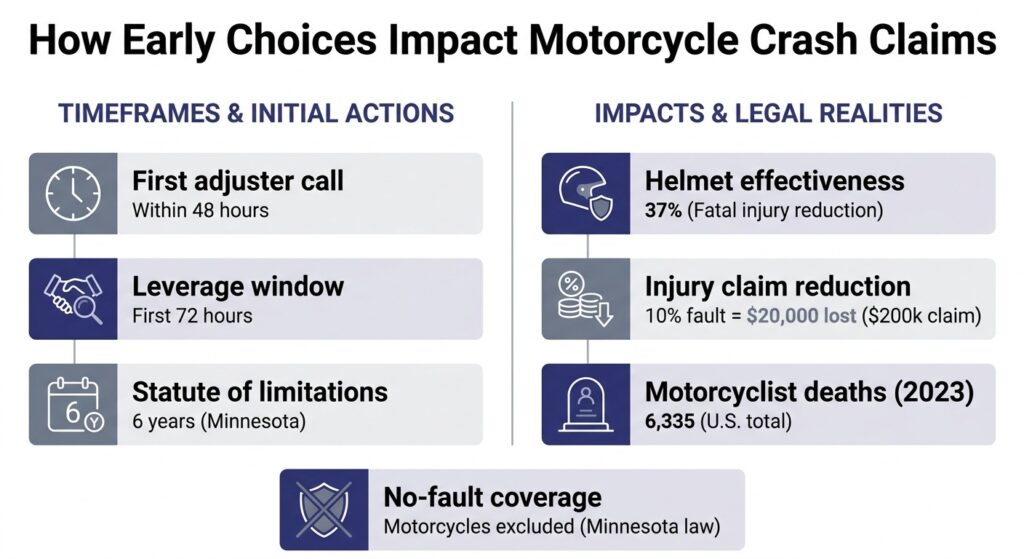
Most riders I talk to after a crash aren’t trying to game the system. They’re tired, they’re hurting, and they just want to get back to normal. So when the insurance adjuster calls within 48 hours sounding reasonable and helpful, it feels like a lifeline. Sign here, take the check, move on.
I’ve watched that moment go wrong more times than I can count. Not because the rider was naive — because nobody told them what was quietly happening on the other side of that phone call.
The Moment That Sets Everything in Motion
Picture this: a rider gets clipped by a left-turning sedan on a Tuesday evening near Lyndale and 38th. He’s shaken, his bike is down, and there’s road rash on his left arm. The police arrive, write up a report, and the other driver’s insurer calls the next morning.
The adjuster is polite. Asks a few questions about how fast he was going and whether the light had changed. He answers honestly. He thinks he’s just telling the story.
Three weeks later, when his shoulder pain turns out to be a torn labrum requiring surgery, that early conversation has already shaped the claim. His speed estimate — offered casually, without context — is now part of the file. His phrasing about the light is being read as ambiguous. The adjuster wasn’t being friendly. They were building a record.
This is the before-and-after that I see constantly in the Twin Cities. The crash itself is one event. The claim is a second event that starts immediately and runs on its own timeline, and most riders don’t realize they’re already in the middle of it.
How the First 72 Hours Shape the Rest of the Claim
The chronology matters more than people expect. What you do — and say — in the first three days can either preserve your leverage or quietly erode it. Here’s how each element plays out:
| Action | What Most Riders Do | What Actually Helps |
|---|---|---|
| Adjuster call | Answer all questions fully | Confirm name and crash occurred; defer details |
| Police report | Assume it settles fault | Obtain a copy and check for errors |
| Bike and gear | Repair or discard quickly | Preserve everything as evidence |
| Witness contact | Assume police handled it | Collect names and numbers at the scene |
The adjuster call. When the other driver’s insurance company calls, they’re not calling to help you. They’re calling to gather information while your memory is fresh and your guard is down. Comparative fault rules mean that anything you say about your speed, your lane position, or your reaction time can be used to assign you a percentage of fault — and in Minnesota, that percentage directly reduces your recovery. You don’t have to be rude. You do have to be careful. Confirming basic facts like your name and that a crash occurred is reasonable. Narrating the entire sequence of events without legal guidance is not.
The police report. Most riders assume the police report settles the fault question. It doesn’t. What it does is create an early official record of scene details — location, time, vehicles involved, contributing circumstances — and federal crash reporting standards make clear that these reports are foundational documents in any subsequent claim. But officers aren’t accident reconstructionists. Their notes may contain errors, incomplete witness accounts, or a fault notation based on limited information. You’re entitled to obtain a copy and, if necessary, challenge inaccuracies before they calcify into accepted fact.
Physical evidence. The bike, the gear, the helmet — these aren’t just property. They’re evidence. NHTSA data shows helmets are roughly 37% effective in preventing fatal rider injuries, which means insurers know exactly how to argue about helmet condition when disputing injury severity. Don’t repair the bike immediately. Don’t throw away damaged gear. Photograph everything before anything is moved or cleaned.
Witness information. People who saw the crash will scatter within hours. Getting names and phone numbers at the scene — or having someone do it for you if you’re injured — is the kind of thing that sounds obvious in retrospect and gets skipped constantly in the chaos of the moment.
Documentation: The Part Nobody Wants to Do When They’re Hurt
This is where I push back hardest on the “just settle and move on” instinct. The documentation phase is where claim value is either built or abandoned. Full stop.
Medical records are your claim’s backbone. The gap between “I was hurt” and “here is documented proof of what I suffered, what it cost, and what it will continue to cost” is enormous. Insurers don’t pay for pain — they pay for documented, verifiable injury. That means going to the ER even if you feel okay, following up with specialists, and not skipping appointments because you’re busy or because you feel like you’re being dramatic. Every missed appointment is a gap in the record that an adjuster will use to argue your injuries weren’t that serious.
Delayed symptoms are real and routinely dismissed. Soft tissue injuries, concussions, and internal injuries don’t always announce themselves at the scene. If you feel fine on day one and wake up with neck pain on day four, that’s not unusual — but if you haven’t established a medical record, the insurer will argue the injury happened elsewhere or isn’t related to the crash.
Keep a pain journal. This sounds small. It isn’t. A daily log of how your injuries affect your sleep, your work, your ability to ride or exercise or pick up your kids — this becomes part of the non-economic damages picture. It’s not about being dramatic. It’s about having a record that reflects what you actually lived through.
A note on gear preservation: If you were wearing proper equipment and the insurer tries to argue your injuries were worsened by inadequate protection, your preserved helmet and gear become a direct rebuttal. Discarding them hands the other side an easy argument.
Fault Determination: How It Evolves and Why It’s Not Fixed
Here’s something most riders don’t realize: fault isn’t determined once.
It gets negotiated, argued, and sometimes litigated over weeks or months. Minnesota follows a modified comparative fault rule, which means you can recover damages as long as you’re found to be less than 51% at fault — but your recovery is reduced by your percentage of fault.
To make that concrete:
- A $200,000 claim where you’re found 10% at fault → you recover $180,000
- The same claim where you’re found 30% at fault → you recover $140,000
- The difference between those two outcomes: $40,000 — often hinging on early statements
This is why what you say early matters so much. An offhand comment about your speed, a vague statement about whether you had time to brake — these get folded into the fault calculation. And once they’re in the file, they’re hard to walk back.
Motorcycle accident laws in Minnesota also include specific considerations around lane splitting (it’s illegal here), helmet requirements, and how comparative fault applies to riders. These aren’t abstract legal points. They’re the framework an adjuster uses to evaluate your claim before you ever see a settlement number.
The police report may show the other driver cited for failure to yield. That’s meaningful, but it doesn’t automatically mean you bear zero fault. Insurers routinely argue that a rider’s speed or positioning contributed to the crash even when the other driver was cited. Understanding this dynamic — that fault determination is a process, not a verdict — is one of the most important shifts in thinking I try to help riders make.
“I Don’t Need a Lawyer — It’s Pretty Straightforward”
I hear this constantly. And I understand it.
Nobody wants to feel like they’re escalating a situation. Nobody wants to be the person who “lawyered up” over a fender bender. And honestly, not every motorcycle crash requires a personal injury attorney.
But here’s what I’ve seen: the claims that look straightforward at first are often the ones that get complicated quietly. A soft tissue injury that turns into a surgery. A fault dispute that surfaces two months in. A medical bill that exceeds the initial settlement offer by three times.
A boston motorcycle accident attorney — or any experienced motorcycle injury attorney in your area — doesn’t just file lawsuits. The more immediate value is in the early guidance: knowing what not to say to the adjuster, understanding what your medical records need to show, and recognizing when a settlement offer is genuinely fair versus when it’s designed to close a claim before the full picture emerges.
What changes when you have representation:
- The adjuster’s tone changes — you’re no longer the easiest path to a closed file
- The documentation process gets structured by someone who knows what gaps will be exploited
- The timeline shifts — you stop being rushed toward a number that benefits the insurer
- You stop navigating a system designed by professionals while you’re also trying to heal
The other thing worth knowing: most personal injury attorneys who handle motorcycle claims work on contingency. You don’t pay unless they recover something for you. The financial barrier that keeps riders from even making a call is often not what they think it is.
Minnesota’s Legal Framework: What Matters Here
A few specifics that change the math for Minnesota riders:
Statute of limitations. Six years for personal injury claims — longer than many states. That’s not an invitation to delay. It’s a reason not to panic into a premature settlement.
No-fault exclusion. Minnesota operates under a no-fault insurance system for some benefits, but motorcycle riders are specifically excluded from the state’s no-fault PIP (Personal Injury Protection) coverage. This means riders are more dependent on the at-fault driver’s liability coverage and their own underinsured motorist coverage than car drivers typically are. Knowing this before you negotiate matters.
The scale of what’s at stake. Federal fatality data shows 6,335 motorcyclists were killed in U.S. traffic crashes in 2023. These claims aren’t minor fender-bender disputes. They involve real injuries, real financial stakes, and a legal framework that rewards the side that’s better prepared.
One Step Before You Decide Anything
You don’t have to file a lawsuit. You don’t have to hire anyone today.
But before you accept any offer or give any recorded statement, take one step: talk to someone who has seen these claims from both sides. Not because you’re being aggressive — because you’re being careful. There’s a meaningful difference between being money-hungry and making sure you don’t sign away your right to cover a surgery you don’t know you need yet.
Slow is safe here. The adjuster’s timeline isn’t your timeline, and you’re allowed to take the time to understand what you’re actually deciding.