
The check arrived before you even finished sorting your medical bills. That speed felt like a relief. I want you to sit with something, though: the insurance company’s efficiency is not the same as your fairness.
I spent years on the defense side of these cases, watching how quickly first-party claims move when an insurer wants them to. Now I work with the people who cashed those checks and called me six months later, confused about why their wage loss still wasn’t covered, or why their doctor’s notes didn’t match what the adjuster had on file. The pattern is consistent enough that I feel compelled to write this down.
When “Handled” Doesn’t Mean “Resolved”
Picture two people. Both were rear-ended at a stoplight in suburban Detroit. Both received PIP payments within two weeks.
| Claimant | Injury | Outcome |
|---|---|---|
| Person A | Soft-tissue soreness, resolved in one month | Fast payment was genuinely appropriate |
| Person B | Herniated disc, didn’t fully declare until week six | Accepted initial payment, missed window for additional wage-loss benefits |
Same speed. Completely different outcomes.
That gap is what I work in. The first person did fine. The second person didn’t lose rights because the insurer was predatory — he lost ground because he didn’t understand what the payment actually covered, and what it left open.
What No-Fault Insurance Actually Does (and Doesn’t Do)
No-fault insurance exists to remove the friction from immediate post-accident recovery. In Michigan, New York, and Pennsylvania, the law requires your own insurer to pay your initial medical costs and a portion of lost wages regardless of who caused the crash. That’s the “no-fault” part — fault is temporarily irrelevant to your first-party claim.
Personal injury protection, or PIP, is the specific coverage that funds this. As an insurance policyholder in a no-fault state, you’re not filing against the other driver’s insurer first. You’re filing against your own policy. That distinction matters more than most people realize, because it means the adjuster you’re dealing with works for your company — and your company has an interest in resolving claims at the lowest defensible number.
What PIP typically covers:
- Emergency and ongoing medical expenses
- A percentage of lost wages
- Replacement services (paying someone to perform household tasks you can’t manage while injured)
What PIP does not cover:
- Pain and suffering
- Emotional distress
- Long-term disability beyond the policy’s benefit window
Michigan’s official no-fault guidance confirms that PIP wage-loss and replacement-service benefits are payable for up to three years after the accident date — which sounds generous until you realize that clock starts immediately, and many people don’t begin tracking it seriously until months in.
The other thing no-fault doesn’t do: it doesn’t automatically close the door on a separate personal injury lawsuit. That’s the piece most first-time claimants don’t know exists.
The Timeline That Quietly Controls Your Options
Here’s where things get procedurally dangerous for people who assume a fast payment means everything is settled.
New York requires you to file your no-fault application within 30 days of the accident. Miss that window and your insurer can deny the entire claim — not reduce it, deny it. The NY no-fault filing rules require specific forms, including the NF-2 application, and incomplete or late submissions give insurers a clean procedural basis for denial. This isn’t a technicality buried in fine print; it’s a hard deadline that catches people who assumed their verbal report to the insurer was sufficient.
Pennsylvania operates under a “choice” no-fault system. You may have already selected — possibly years ago when you bought your policy — whether you retain the right to sue for pain and suffering. If you chose the “limited tort” option to save on premiums, your threshold for stepping outside no-fault is higher. Most people don’t remember making that choice.
Michigan’s system is the most complex of the three. The 2019 reforms created tiered PIP coverage levels, meaning two people in the same accident might have dramatically different medical benefit caps depending on what their policies say. If you’re in Michigan and you’re not certain which PIP tier you selected, that’s the first call you need to make — not to your adjuster, but to your own policy documents.
The timeline concern isn’t just about filing deadlines. Soft tissue injuries, concussions, and disc problems often worsen or become clearer in the weeks after an accident. If your medical provider isn’t documenting the progression of your symptoms carefully — every visit, every complaint, every functional limitation — the adjuster’s file will reflect a picture that looks like recovery, even when your reality is different.
The Threshold Question Nobody Explains at the Scene
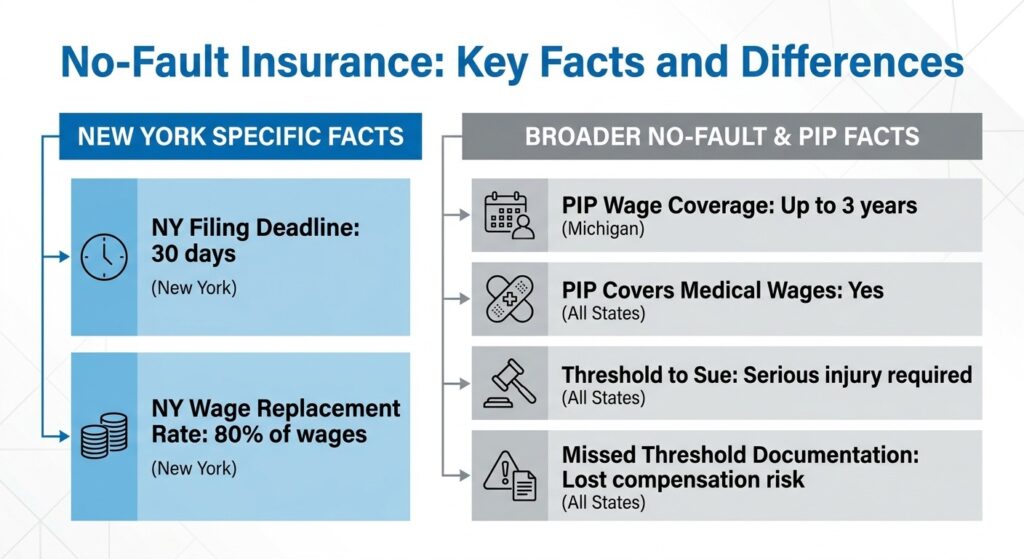
This is the part of no-fault law that creates the most confusion, and the most lost compensation.
Every no-fault state has a threshold — a legal standard that, if your injury meets it, allows you to step outside the no-fault system and pursue a personal injury claim against the at-fault driver for damages PIP doesn’t cover.
Q: What is New York’s serious injury threshold? Significant disfigurement, fracture, permanent limitation of a body organ or member, or a medically determined injury preventing you from performing substantially all daily activities for 90 of the 180 days following the accident.
Q: What does “medically determined” actually mean in practice? Your medical provider must document the injury in clinical language, with objective findings — not just your self-reported pain level. An adjuster reviewing your file is not looking for reasons to flag your injury as threshold-meeting. They’re evaluating whether the documentation supports continued PIP payment. Those are different analyses.
If you’re in New York and you missed more than 90 days of normal activity, but your doctor’s notes only say “patient reports discomfort” rather than documenting functional limitations with objective findings, you may have a threshold injury that the record doesn’t support. That’s not the insurer’s fault. That’s a documentation gap between what your body experienced and what your medical provider wrote down.
For Michigan claimants, the threshold is “serious impairment of body function” — an objectively manifested impairment that affects your general ability to lead your normal life. Pennsylvania’s limited tort threshold requires “serious injury” as well, though defined somewhat differently. The point across all three states: a fast PIP payment does not mean your injury didn’t meet the threshold. It means the threshold question hasn’t been asked yet.
If you’re wondering whether your situation warrants that analysis, consulting a personal injury attorney ma or a no-fault specialist in your state is the appropriate next step — not to file a lawsuit, but to understand whether the threshold question is even on the table.
What the Adjuster Is Evaluating vs. What You Think They’re Doing
People often assume the insurance adjuster’s job is to figure out what you’re owed.
That’s not quite right.
The adjuster’s job is to evaluate what the policy requires the insurer to pay, based on the documentation in front of them. They’re not your advocate. They’re not your enemy either — but they’re working within a system designed to resolve claims efficiently, and “efficiently” in insurance means within documented parameters. What this means practically: the adjuster is looking at your medical provider’s records, your employer’s wage verification, and your policy’s coverage tier. If your provider submitted billing codes that don’t match the injury narrative, or if your employer’s wage documentation is incomplete, the adjuster will process what’s there — not what should be there.
Two additional details that catch people off guard:
- New York’s 20% wage offset. The statutory wage offset means the system is designed to pay you 80% of your pre-accident wages, not 100%. Many claimants assume a wage-loss payment equals full income replacement. It doesn’t. If you’re calculating whether the payment covered your actual income loss, subtract 20% from your gross wages before comparing.
- Exhausted PIP benefits. If your basic PIP benefits run out — which can happen with serious injuries requiring extended treatment — additional coverage options exist through supplemental PIP on your policy or a household member’s policy, and ultimately through your standard health insurance. Most claimants don’t know to ask about additional PIP until they’ve already hit the limit.
A Practical Triage Checklist
Before you decide whether your claim is truly resolved, work through these:
On your PIP claim:
- Do you know your policy’s specific PIP coverage tier and benefit limits?
- Have you confirmed the adjuster’s file reflects all your medical visits and documented symptoms?
- If you’re in New York, did you file the NF-2 within 30 days?
On your medical documentation:
- Is your provider recording functional limitations — not just pain, but what you can’t do?
- Are follow-up appointments scheduled if symptoms persist or worsen?
On the threshold question:
- Have you had a frank conversation with a no-fault-experienced attorney about whether your injury might qualify for a separate personal injury claim?
- This conversation costs nothing and doesn’t commit you to litigation.
On wage loss:
- If you’re in New York, are you accounting for the 20% offset?
- Have you submitted complete employer wage verification?
A fast payment means the no-fault system worked as designed for your immediate bills. It does not mean the full picture of your rights has been evaluated.
Where to Go From Here
Start with your state’s insurance department. The New York Department of Financial Services no-fault FAQ is genuinely useful, as is Michigan’s consumer auto insurance guide. Both are written for non-lawyers and answer the most common procedural questions without requiring you to contact anyone.
For threshold injury analysis or situations where you suspect your documentation is incomplete, a no-fault-experienced plaintiff’s attorney — not a general practice firm — is the right resource. Most offer free consultations. Use them to ask specific questions, not to hand off your case before you understand it.
The goal here isn’t to make you suspicious of every payment. It’s to make sure you know what the payment covered — and what it didn’t.